HTTP Status Codes
HTTP 500 Internal Server Error
Internal Server Error — the server hit an unexpected condition while handling the request
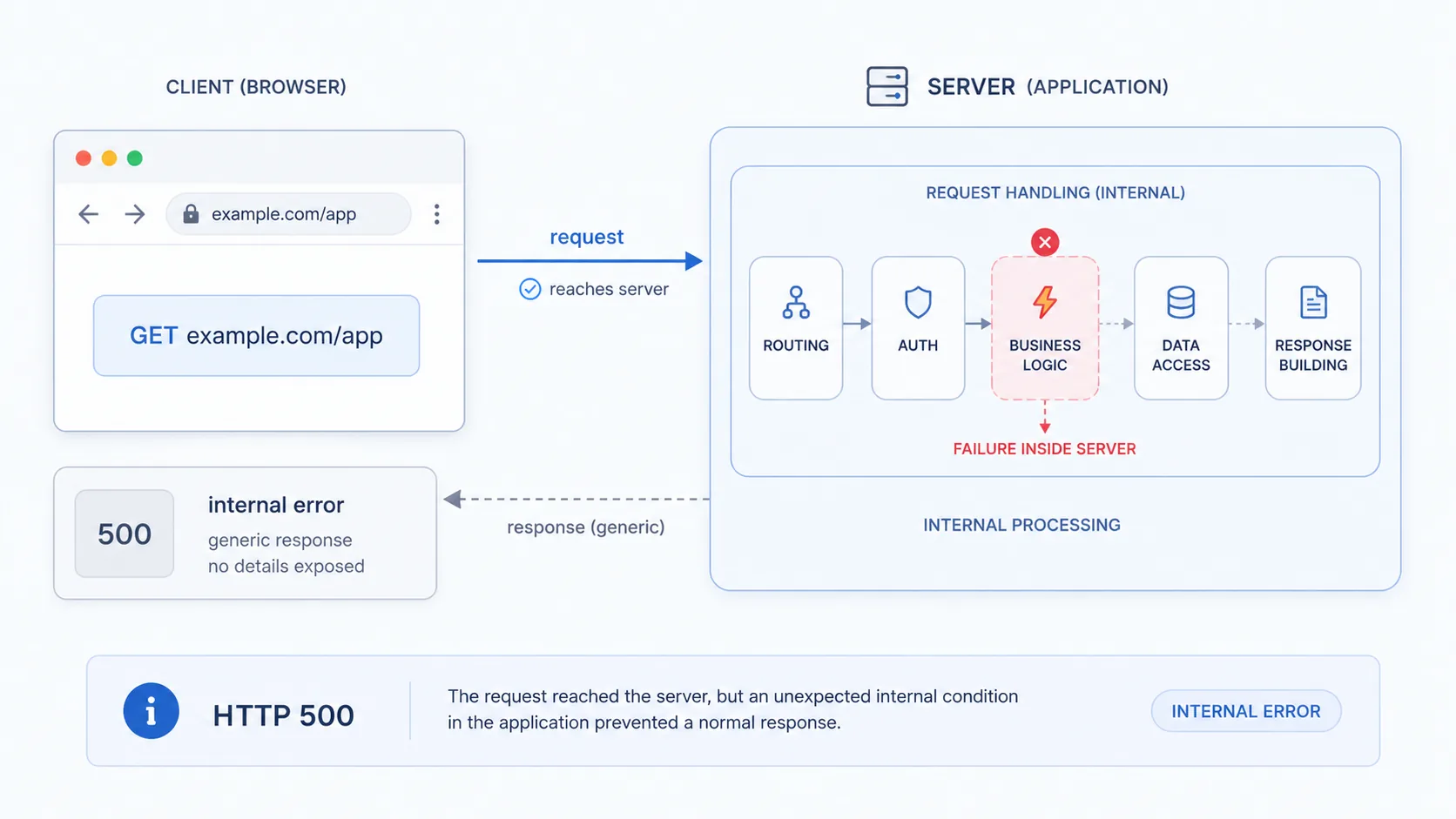
A 500 Internal Server Error is the generic response for an unexpected server-side failure when no narrower 5xx status is being exposed to the client. The request reached the application, but normal response generation broke before the server could complete it successfully.
Visual summary
A quick reference view of how HTTP 500 signals a generic internal server-side failure after the request reached the application.
What 500 Means
The shortest useful reading of this status code.
Internal Server Error means the server hit an unexpected condition while handling the request.
For generic server failures, the key distinction is that the server knows something went wrong internally but is not exposing a more specific public status code.
Quick read
Server failed internally
A 500 means the request reached the server, but an unexpected internal failure prevented a normal response.
Technical Context
How this status behaves without turning the page into a repair guide.
Generic server failure
A 500 is the broad fallback for internal failures. It means the server knows something went wrong while processing the request, but the public response is not being narrowed to a more specific status such as 502, 503, or 504.
Application boundary
Its closest contrast is scope. A 500 points inward to the application or origin server itself, while 502 and 504 point to failures in an upstream or proxy chain, and 503 points to temporary overload or maintenance. In other words, 500 is the most generic way to say the server-side handling failed.
Specificity contrast
That is why one isolated 500 often suggests a route-specific bug or rendering path problem, while widespread 500 responses usually indicate a broader application or dependency failure affecting much more of the site.
Related HTTP Codes
Nearby HTTP status codes help clarify how 500 differs inside the same response family.
500
Internal Server Error
the server hit an unexpected condition while handling the request
502
Bad Gateway
the server received an invalid response from an upstream server
503
Service Unavailable
the server is temporarily unable to handle this request
504
Gateway Timeout
the gateway did not receive an upstream response in time
Common Causes
Unhandled exception in application code
The request reached the application, but execution failed before a more specific response path was chosen.
Application dependency returns an unexpected state
The server encountered an internal condition it did not map to a narrower public status code.
Template, rendering, or serialization failure
The route exists, but response generation breaks while the server is assembling output.
Database or internal service dependency fails inside the app
The fault happens within the application's own execution path rather than at a separate gateway hop.
Typical Scenarios
A deployment introduces an application bug that causes one route or many routes to fail immediately
A server-side template or serializer crashes while building the response payload
A database or internal dependency fails inside the application request flow
What To Know
A 500 can be isolated to one route or spread across the whole site depending on where the internal failure sits. If many unrelated URLs return 500 together, the broader pattern usually reflects a shared application or dependency problem rather than a single missing page.
Frequently Asked Questions
Common interpretation questions about HTTP 500.
Common causes include unhandled application exceptions, failed internal dependencies, rendering problems, and other server-side conditions that do not map to a more specific public status.
No. A 500 points to an internal server or application failure. A 502 or 504 points to a problem in communication with another server upstream.
Not always. One route can return 500 while others still work. A sitewide 500 pattern usually means the internal failure sits in shared application logic or infrastructure.