HTTP Status Codes
HTTP 100 Continue
Continue — server received preliminary request headers and client can transmit body
A 100 Continue status is an interim informational response indicating that the server has processed initial request headers and determined the client should proceed with sending the request payload. It prevents clients from transmitting massive request bodies across the network if the server intends to reject the request based on authorization, content type, or size limits.
Visual summary
A quick reference view of how HTTP 100 works: A gatekeeper acknowledging the first piece of data and leaving the gate open for the remainder.
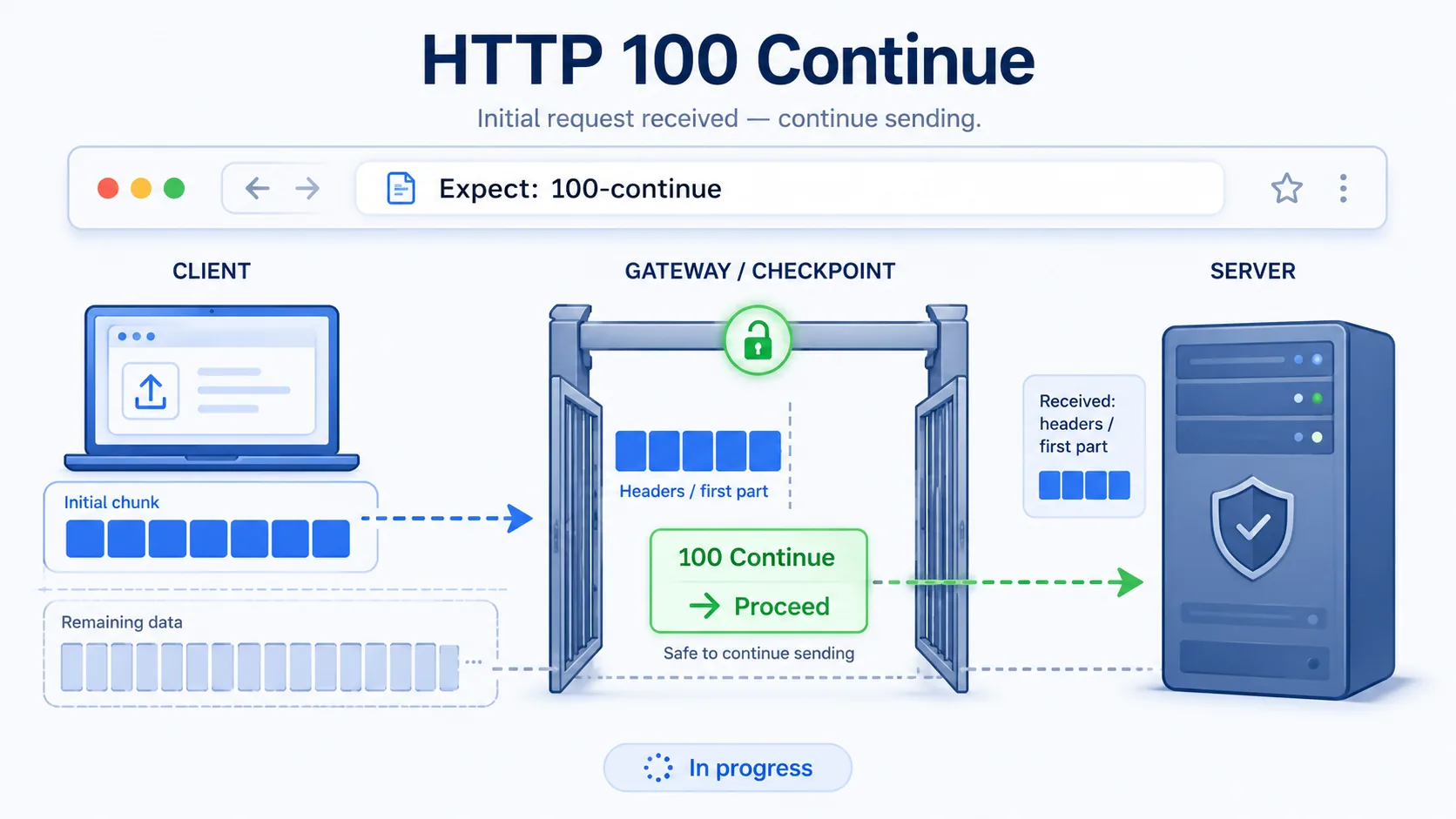
What 100 Means
The shortest useful reading of this status code.
Continue means server received preliminary request headers and client can transmit body.
This status falls into the 1xx class, indicating a informational outcome for the request.
Quick read
Continue
server received preliminary request headers and client can transmit body
Technical Context
How this status behaves without turning the page into a repair guide.
Standard usage
The 100 Continue status acts as an operational checkpoint in HTTP/1.1 and HTTP/2 request lifecycles. When a client intends to send a large payload, it includes the Expect header so the server can evaluate authentication, rate limits, and header syntax immediately.
Technical nuance
If the server approves the headers, it sends a 100 Continue response, prompting the client to transmit the remaining body. If the server rejects the request (such as with 401 Unauthorized or 413 Payload Too Large), it responds immediately, preventing unnecessary bandwidth consumption.
Related HTTP Codes
Nearby HTTP status codes help clarify how 100 differs inside the same response family.
100
Continue
server received preliminary request headers and client can transmit body
101
Switching Protocols
the server is switching to the protocol requested by the client
103
Early Hints
the server is sending preliminary response headers before the final response
417
Expectation Failed
the server cannot satisfy the request's Expect header requirements
Common Causes
Client transmitted an Expect: 100-continue header prior to sending a large payload
A common condition that triggers a 100 response when the web server evaluates the transaction.
Multi-part file upload handshake checking server authorization before transmission
A common condition that triggers a 100 response when the web server evaluates the transaction.
API gateway validating payload length constraints before proxying data to upstream services
A common condition that triggers a 100 response when the web server evaluates the transaction.
Typical Scenarios
An automated API client requests confirmation via Expect: 100-continue before uploading a multi-gigabyte archive
A reverse proxy verifies upstream connectivity before accepting a streamed POST request body
A web browser tests endpoint authorization before transmitting a large form submission
What To Know
Seeing 100 Continue in network logs confirms a successful pre-flight header handshake. Standard HTTP client libraries process this interim code transparently before awaiting the final status.
Frequently Asked Questions
Common interpretation questions about HTTP 100.
No. It only confirms that the server accepted the initial headers and is ready to receive the body. The final operation may still return 200, 400, or 500 once the body is evaluated.
It avoids wasting network bandwidth by transmitting large payloads only after confirming the server will not reject the request based on headers alone.