HTTP Status Codes
HTTP 418 I'm a teapot
I'm a teapot — server refuses to brew coffee because it is permanently a teapot
Status 418 I'm a teapot is an experimental HTTP status code defined in RFC 2324 as an April Fools joke in 1998. It has since become a widely recognized cultural artifact in computer networking, implemented by major web frameworks, search engines, and developer APIs as an easter egg response.
Visual summary
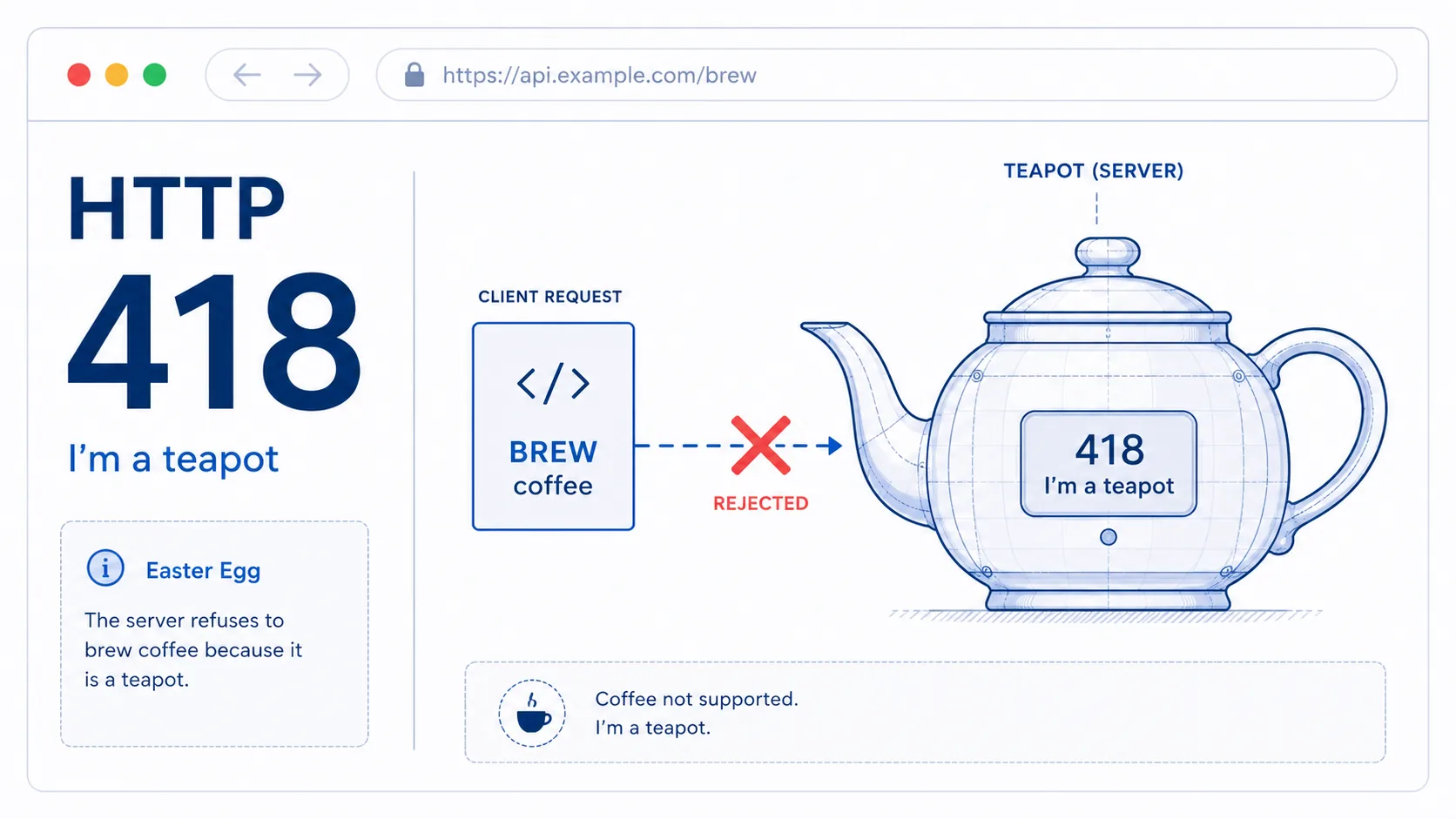
A quick reference view of how HTTP 418 works: A sleek, diagrammatic teapot rejecting a coffee-related request.
What 418 Means
The shortest useful reading of this status code.
I'm a teapot means server refuses to brew coffee because it is permanently a teapot.
This status falls into the 4xx class, indicating a client-side error outcome for the request.
Quick read
I'm a teapot
server refuses to brew coffee because it is permanently a teapot
Technical Context
How this status behaves without turning the page into a repair guide.
Standard usage
Originally specified in RFC 2324 as part of the Hyper Text Coffee Pot Control Protocol (HTCPCP), the 418 code was specified for teapots requested to brew coffee. Despite its origins as satire, it was implemented across numerous software libraries, including Node.js, Go, Python, and ASP.NET.
Technical nuance
Efforts to remove or repurpose status 418 in standards bodies were met with widespread developer advocacy, leading to its formal reservation in RFC 9110 to preserve its historical and educational significance.
Related HTTP Codes
Nearby HTTP status codes help clarify how 418 differs inside the same response family.
418
I'm a teapot
server refuses to brew coffee because it is permanently a teapot
400
Bad Request
the server cannot process the request because it is malformed
404
Not Found
the server cannot find the requested resource at this URL
500
Internal Server Error
the server hit an unexpected condition while handling the request
Common Causes
RFC 2324 Hyper Text Coffee Pot Control Protocol demonstration
A common condition that triggers a 418 response when the web server evaluates the transaction.
API endpoint returning deliberate easter egg response for unexpected beverage commands
A common condition that triggers a 418 response when the web server evaluates the transaction.
Web application framework using 418 as an intentional sentinel or mock test response
A common condition that triggers a 418 response when the web server evaluates the transaction.
Typical Scenarios
A developer queries a mock test endpoint configured to return 418 during system verification
An API returns 418 as an easter egg when receiving nonsensical or humorous request parameters
A web application uses 418 to signal that an endpoint is intentionally non-operational
What To Know
Encountering a 418 status indicates an intentional easter egg, mock test endpoint, or humorous sentinel response. It is not an infrastructure malfunction.
Frequently Asked Questions
Common interpretation questions about HTTP 418.
It was originally an April Fools RFC (RFC 2324), but RFC 9110 formally reserved it as a recognized status code due to widespread implementation.
Many web services and frameworks include 418 as an easter egg, sentinel value for testing, or to indicate deliberately unsupported operations.