HTTP Status Codes
HTTP 226 IM Used
IM Used — the server fulfilled a delta-encoding request for the resource
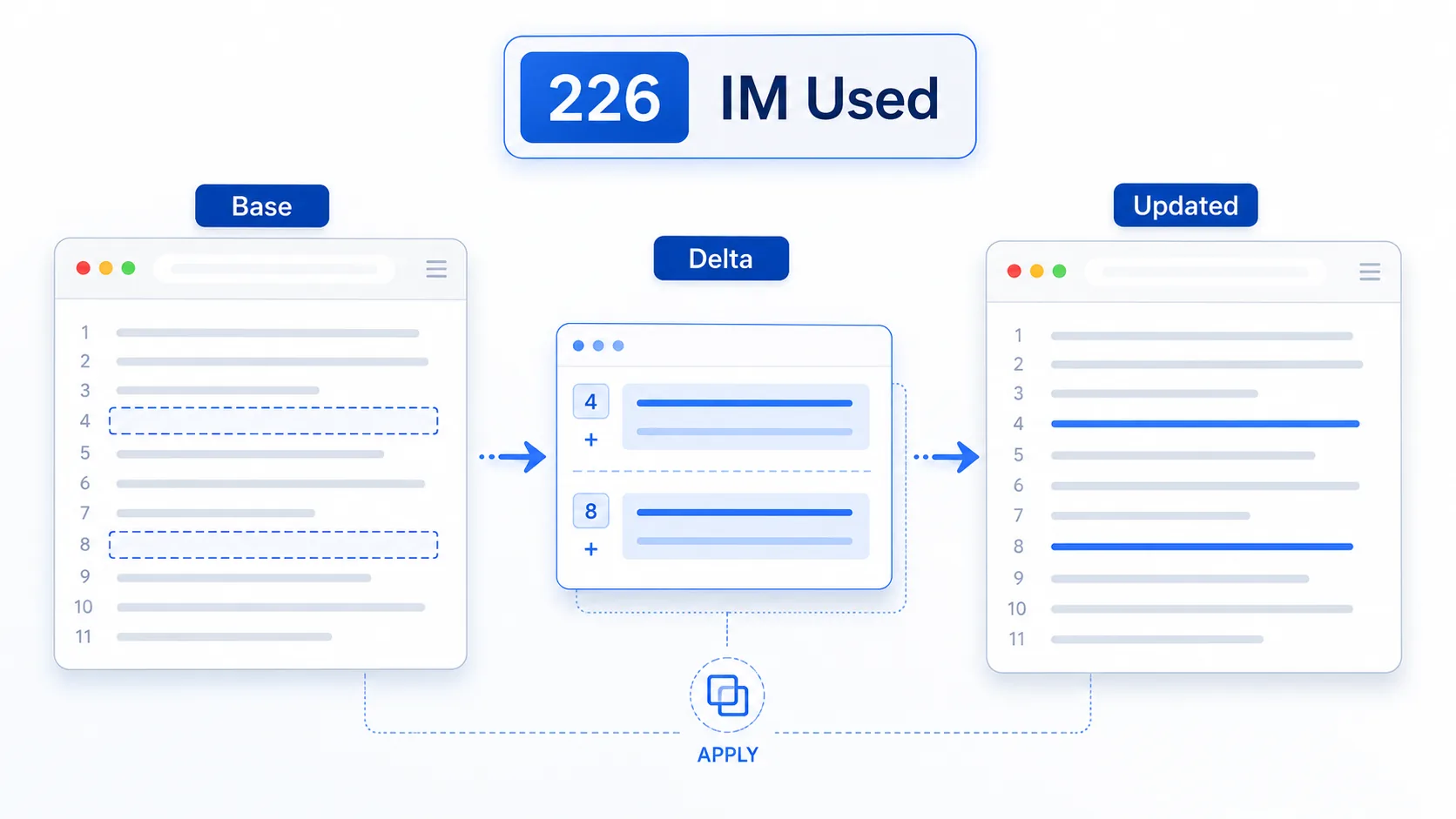
A 226 IM Used response indicates the server has fulfilled a GET request for the resource, and the response is a representation of the result of one or more instance-manipulations applied to the current instance.
Visual summary
A quick reference view of how HTTP 226 works: A patch or diff being overlaid onto an existing cached instance.
What 226 Means
The shortest useful reading of this status code.
IM Used means the server fulfilled a delta-encoding request for the resource.
This status falls into the 2xx class, indicating a successful outcome for the request.
Quick read
IM Used
the server fulfilled a delta-encoding request for the resource
Technical Context
How this status behaves without turning the page into a repair guide.
Standard usage
The 226 IM Used status code is part of the HTTP delta encoding extension. It tells the client that the server performed one or more 'instance manipulations' to produce the response, rather than serving the full resource.
Technical nuance
Delta encoding reduces bandwidth by transmitting only the differences between the current and previous version of a resource. While this concept is powerful, 226 has not seen widespread adoption because modern CDNs and compression algorithms have largely solved the bandwidth problem it was designed to address.
Implementation detail
The 226 status code was introduced in RFC 3229 to support instance manipulation via delta encoding. Unlike standard content negotiation which selects among different representations, 226 signals that the server applied a delta transform to produce the response body, allowing clients to request only the changes between their cached version and the current version.
Related HTTP Codes
Nearby HTTP status codes help clarify how 226 differs inside the same response family.
226
IM Used
the server fulfilled a delta-encoding request for the resource
200
OK
the request succeeded and the server returned the expected response
206
HTTP 206 Partial Content
the server is sending a requested range
304
Not Modified
cached copy on client remains valid and fresh
Common Causes
Client requested delta encoding and the server supports instance manipulations
A common condition that triggers a 226 response when the web server evaluates the transaction.
A feed reader requested only the changes since its last fetch
A common condition that triggers a 226 response when the web server evaluates the transaction.
The server applied one or more instance manipulations to produce the response
A common condition that triggers a 226 response when the web server evaluates the transaction.
Typical Scenarios
An RSS feed aggregator uses delta encoding to fetch only new articles since its last request
A bandwidth-constrained client requests incremental updates to a large resource instead of re-downloading it entirely
What To Know
The 226 status code represents a niche optimization. Its presence confirms successful delta encoding between the server and client rather than indicating any error condition.
Frequently Asked Questions
Common interpretation questions about HTTP 226.
Virtually never. This status code is defined for specialized delta-encoding scenarios and is extremely rare in standard web browsing.
Delta encoding requires both client and server to support RFC 3229 instance manipulation, which most web servers and clients do not implement. The standard HTTP caching ecosystem already handles many bandwidth-saving scenarios that 226 was designed for.
206 returns a byte range of the full resource as requested by the client. 226 returns a transformed representation where the server applied an operation like delta encoding. 206 is about slicing; 226 is about transforming.