HTTP Status Codes
HTTP 414 URI Too Long
URI Too Long — the requested URL exceeds the server length limit
A 414 URI Too Long status indicates the server is refusing to service the request because the requested URI string is longer than the server is configured or willing to interpret. It points directly to URL bloat.
Visual summary
A quick reference view of how HTTP 414 works: An excessively long text string overflowing its designated address buffer.
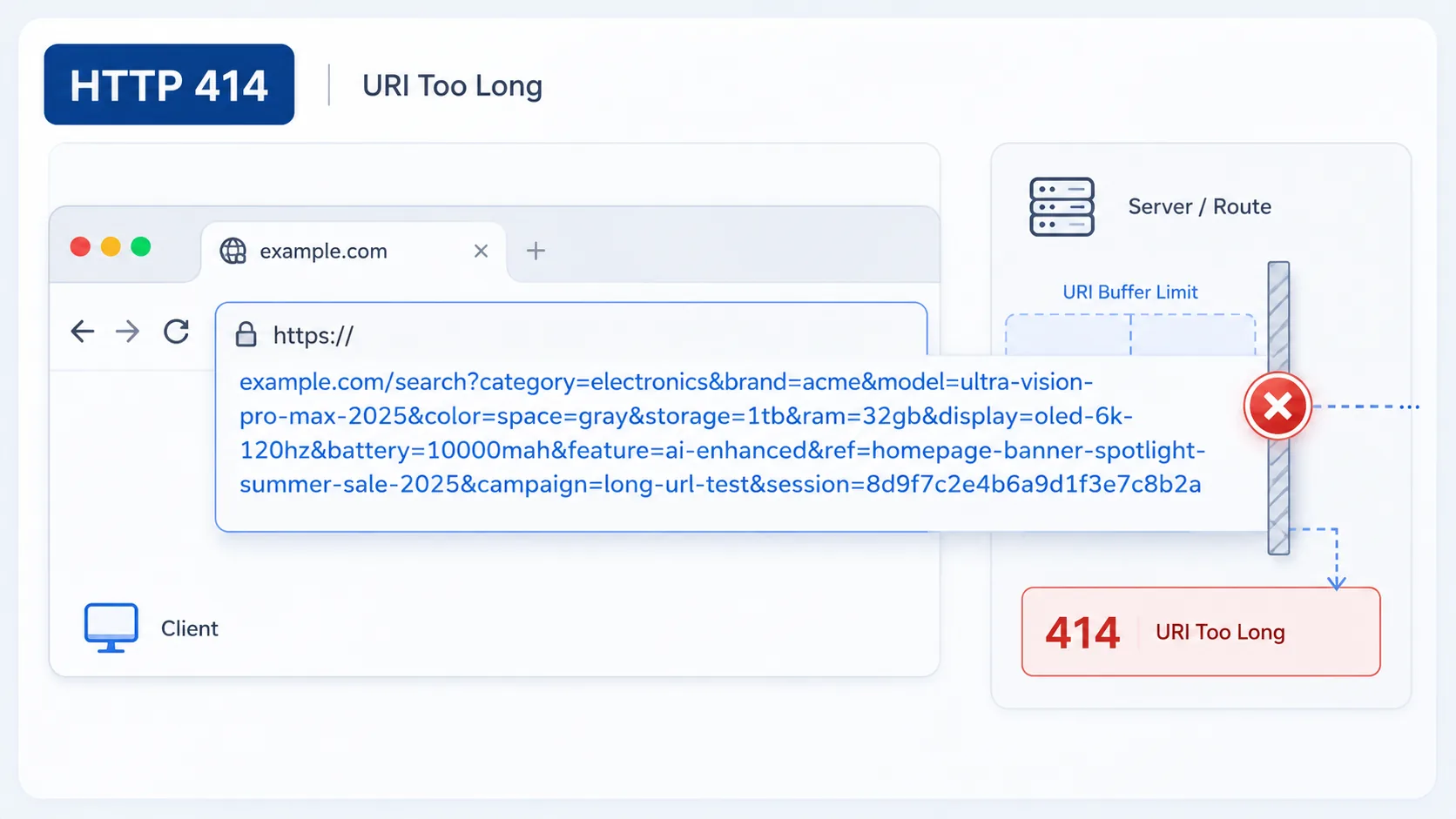
What 414 Means
The shortest useful reading of this status code.
URI Too Long means the requested URL exceeds the server length limit.
This status falls into the 4xx class, indicating a client-side error outcome for the request.
Quick read
URI Too Long
the requested URL exceeds the server length limit
How to fix 414
General informational guidance, not professional advice. Commands can affect your system or data — back up first and proceed at your own risk. FixerCode is an independent reference, not affiliated with any vendor mentioned.
Move the data out of the query string
Send large or numerous parameters in a request body instead of the URL. A POST with a JSON body avoids the URL length limit entirely.
curl -X POST -H 'Content-Type: application/json' -d @payload.json https://example.com/apiRaise the Nginx header buffers if you own the server
Increase large_client_header_buffers for legitimately long URLs, then reload Nginx.
large_client_header_buffers 4 16k;Break any redirect loop appending parameters
A loop that keeps stacking the same query parameters eventually overflows the limit. Find and fix the loop rather than raising buffers forever.
Shorten long identifiers in the URL
Replace long encoded values with a short key or hash that the server can expand on its side.
Technical Context
How this status behaves without turning the page into a repair guide.
Standard usage
The 414 response is a boundary defense mechanism. While HTTP does not formally place a hard ceiling on URL length, web servers allocate fixed memory buffers to read request lines efficiently. A URI that overruns these buffers is instantly rejected.
Technical nuance
This error is extremely rare in modern web operations unless a client makes an architectural mistake. Passing large structured datasets or bulk form contents via GET query strings instead of a proper POST body is the classic trigger.
Implementation detail
Sometimes security scanning or malicious probing will intentionally throw immense strings at a server just to measure buffer limits, triggering 414 responses continuously across the application logs.
Related HTTP Codes
Nearby HTTP status codes help clarify how 414 differs inside the same response family.
414
URI Too Long
the requested URL exceeds the server length limit
400
Bad Request
the server cannot process the request because it is malformed
413
Content Too Large
the request body is larger than the server allows
431
Request Header Fields Too Large
the header section exceeds accepted size limits
Common Causes
Excessive query string parameters appended to a GET request
A common condition that triggers a 414 response when the web server evaluates the transaction.
Accidental redirect loops appending the exact same string endlessly
A common condition that triggers a 414 response when the web server evaluates the transaction.
Client application converting a large data payload into URL parameters
A common condition that triggers a 414 response when the web server evaluates the transaction.
Aggressive security tracking tokens bloating the web address
A common condition that triggers a 414 response when the web server evaluates the transaction.
Typical Scenarios
A badly coded JavaScript application attaches thousands of item IDs into a GET parameter URL
A security proxy adds massive tracking signatures to the URL string blocking the destination
A pagination loop incorrectly stacks old query parameters infinitely over consecutive clicks
What To Know
A 414 error is a clear signal that data transmission methods need refactoring. Whenever a frontend application begins hitting URL limits, developers must migrate the data payload from the query string parameters into the formal body of a POST or PUT request.
Frequently Asked Questions
Common interpretation questions about HTTP 414.
The error happens when the web address string is excessively long. This is usually caused by too many parameters added to the URL after a question mark.
There is no single official strict HTTP limit, but practically, most web browsers and server defaults begin rejecting URLs if they stretch past approximately 2000 to 8000 characters.
Structural change of the data transmission method resolves the error. Moving the payload into the body of a POST request, which is designed to handle large datasets, is the standard approach.