HTTP Status Codes
HTTP 200 OK
OK — the request succeeded and the server returned the expected response
A 200 OK is the most common HTTP status code. It confirms that the server understood the request, processed it, and returned the appropriate content in the response body.
Visual summary
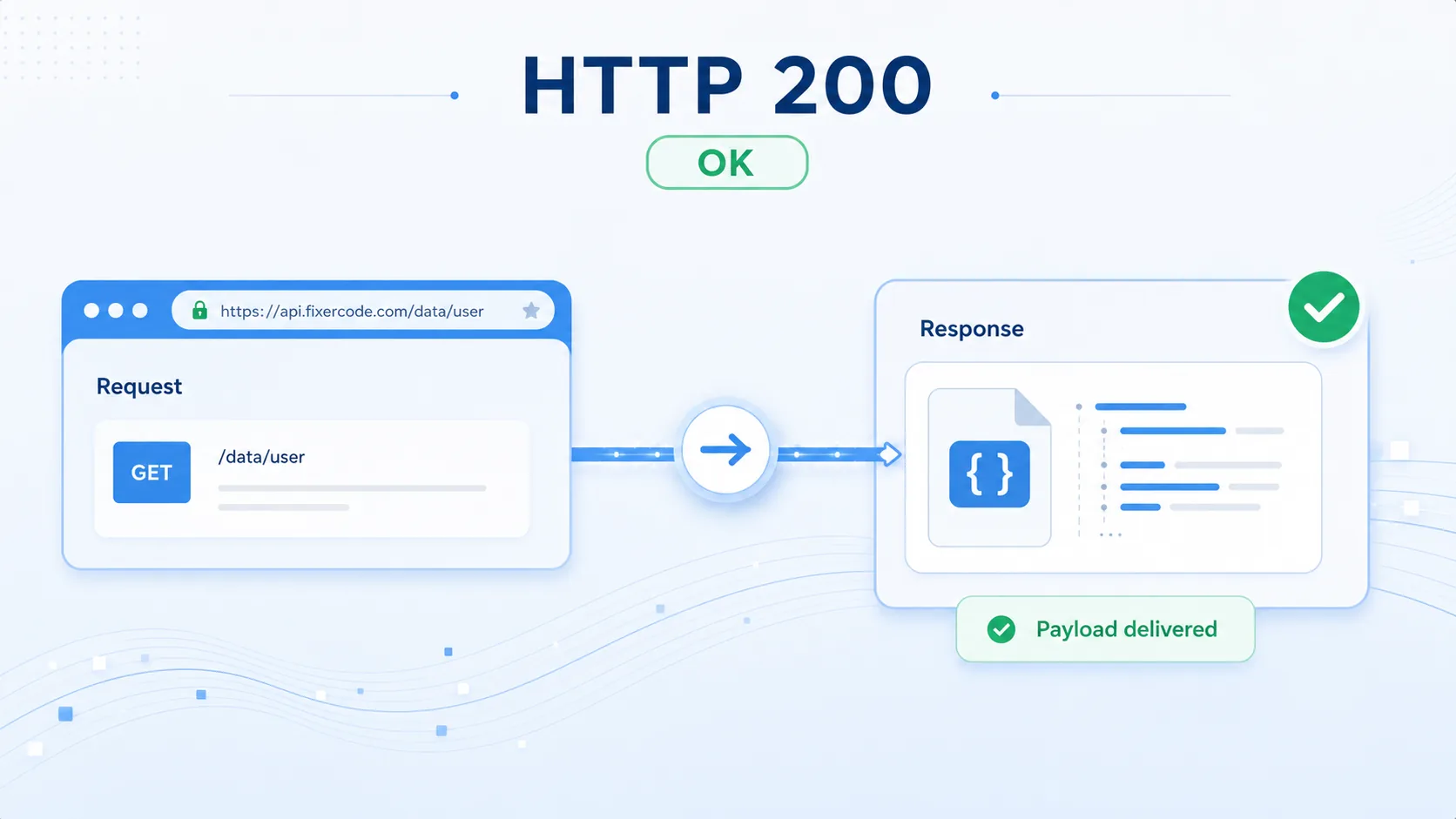
A quick reference view of how HTTP 200 works: A successful transfer of the requested resource.
What 200 Means
The shortest useful reading of this status code.
OK means the request succeeded and the server returned the expected response.
This status falls into the 2xx class, indicating a successful outcome for the request.
Quick read
OK
the request succeeded and the server returned the expected response
Technical Context
How this status behaves without turning the page into a repair guide.
Standard usage
The 200 status code is the standard response for successful HTTP requests. The actual content of the response varies based on the HTTP method: for GET requests, it contains the resource; for POST requests, it contains the result of the action.
Technical nuance
While 200 is universally interpreted as success, the response body can still contain application-level error messages. A JSON API returning {"error": true} with a 200 status is technically a successful HTTP exchange, even though the business logic failed.
Related HTTP Codes
Nearby HTTP status codes help clarify how 200 differs inside the same response family.
200
OK
the request succeeded and the server returned the expected response
201
Created
the request was successful and a new resource was created
204
No Content
the request was successful but there is no content to return
206
HTTP 206 Partial Content
the server is sending a requested range
Common Causes
Standard successful response to a GET, POST, or HEAD request
A common condition that triggers a 200 response when the web server evaluates the transaction.
Server processed the request without encountering any errors
A common condition that triggers a 200 response when the web server evaluates the transaction.
API endpoint returned data matching the query parameters
A common condition that triggers a 200 response when the web server evaluates the transaction.
Typical Scenarios
A browser navigates to a webpage and the server sends back the complete HTML document
An API client sends a valid search query and receives a JSON payload with the results
What To Know
A 200 response confirms that the network layer and server processed the request correctly. Distinguishing HTTP-level success from application-level success requires inspecting the response body content.
Frequently Asked Questions
Common interpretation questions about HTTP 200.
No. The entire 2xx range indicates success. 201 means a resource was created, 204 means success with no content body, and 206 means only a partial range was returned.