HTTP Status Codes
HTTP 431 Request Header Fields Too Large
Request Header Fields Too Large — the header section exceeds accepted size limits
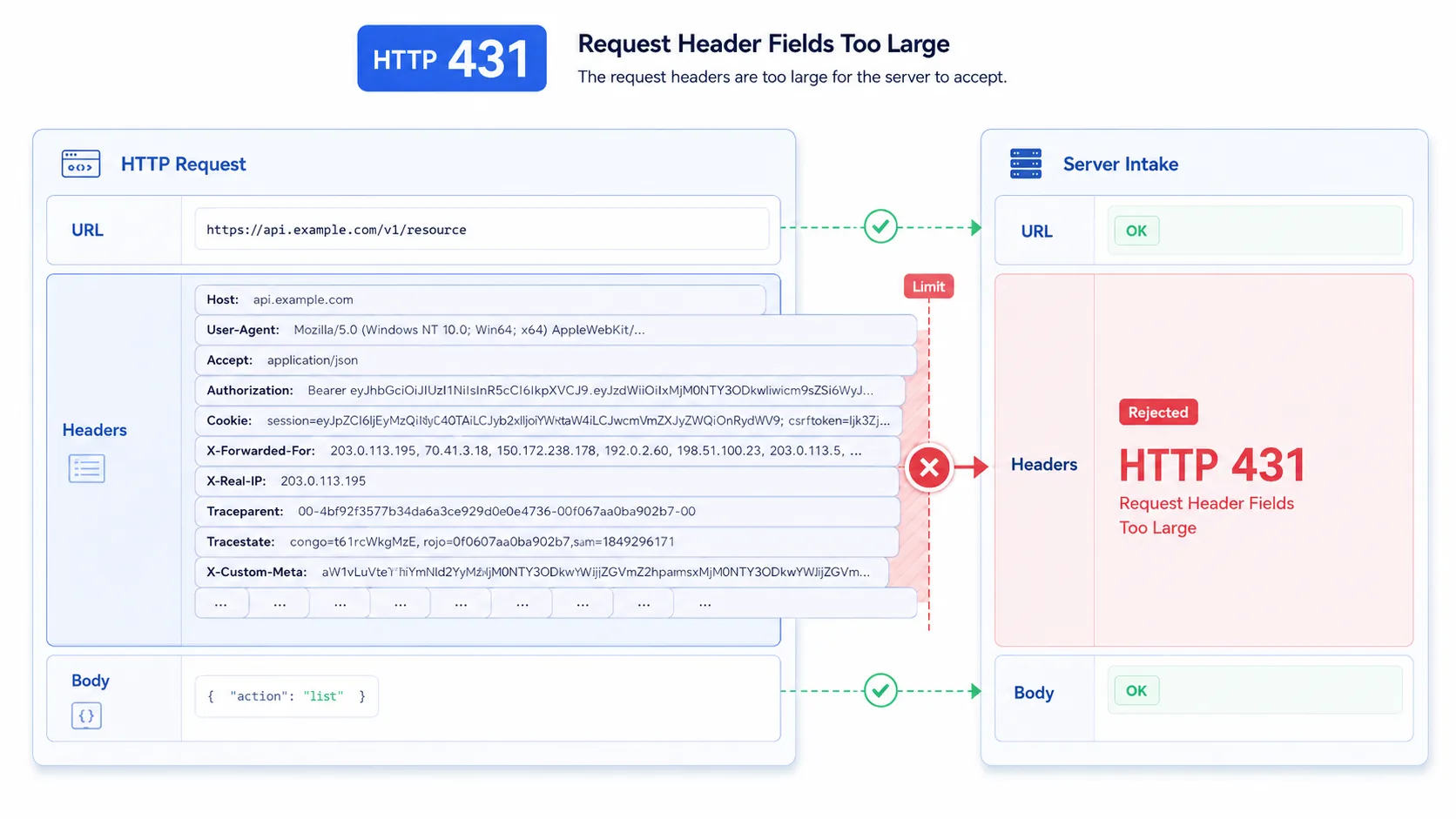
A 431 Request Header Fields Too Large response means the server rejected the request because the header section was too large to accept under its current limits. The problem may be one oversized field or the combined size of the full header block before normal application handling begins.
Visual summary
A quick reference view of how HTTP 431 rejects a request because the header section or one header field is too large before normal handling begins.
What 431 Means
The shortest useful reading of this status code.
Request Header Fields Too Large means the header section exceeds accepted size limits.
For request-size boundaries, the key distinction is that 431 is about the header section, not the body length, body size, or URI length.
Quick read
Header section too large
A 431 means the request headers or one header field exceed what the server is willing to parse.
Technical Context
How this status behaves without turning the page into a repair guide.
Header envelope
A 431 is a request-boundary signal focused on headers, not on the body. The request can target the correct URL and still fail before application routing if cookies, tokens, forwarded metadata, or another header field exceed what the server is willing to parse into memory for normal handling.
Request boundary
That makes 431 a useful contrast with nearby size-related statuses. A 411 is about declaring body length, a 413 is about the body being too large, and a 414 is about the URI itself being too long. A 431 isolates the header section as the part that crossed the limit.
Related HTTP Codes
Nearby HTTP status codes help clarify how 431 differs inside the same response family.
431
Request Header Fields Too Large
the header section exceeds accepted size limits
411
Length Required
the server requires a valid Content-Length header
413
Content Too Large
the request body is larger than the server allows
414
URI Too Long
the requested URL exceeds the server length limit
Common Causes
Cookie data grows beyond the server's header budget
State stored in cookies expands until the request envelope no longer fits accepted header limits.
Forwarded or tracing headers expand the request envelope
Proxy-added metadata can consume the same header space as the client request itself.
One custom header value is longer than allowed
A single oversized header can trigger the rejection even if the rest of the request is small.
Authentication or session tokens bloat the header block
Large tokens increase header size pressure before application logic ever sees the request.
Typical Scenarios
A browser accumulates enough cookies for one domain that future requests exceed the accepted header budget
A proxy chain adds tracing, forwarding, or auth metadata until the full header envelope becomes too large
A client sends one unusually long custom header value that crosses the server limit by itself
What To Know
A 431 usually clusters around one browser state, one proxy path, or one integration pattern rather than around the entire site. The visible pattern fits header-envelope pressure at the start of request processing, not a general content or routing failure.
Frequently Asked Questions
Common interpretation questions about HTTP 431.
It is commonly caused by oversized cookies, large authentication tokens, proxy-added metadata, or one header field that grows beyond the server's accepted limit.
A 431 is about request headers being too large. A 413 is about the request body being too large after framing has progressed far enough to evaluate the payload size.