HTTP Status Codes
HTTP 205 Reset Content
Reset Content — the server asks the client to reset the document view
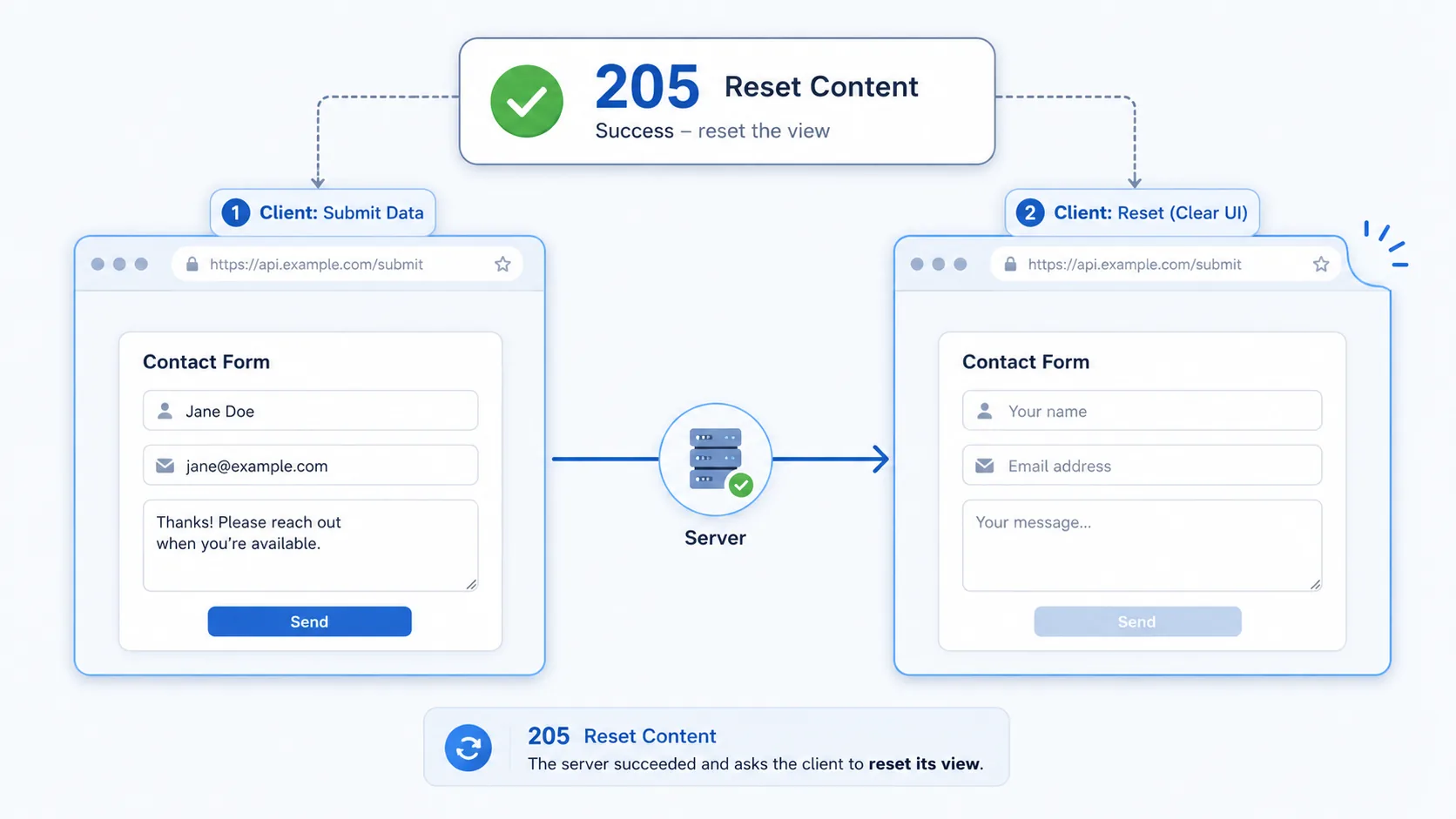
The 205 status is functionally paired with form submissions and data-entry workflows. After a successful POST, the server uses 205 instead of 204 to signal that the client-side input surface should return to its blank or default state.
Visual summary
A quick reference view of how HTTP 205 works: A client UI or form being wiped clean after a successful submission.
What 205 Means
The shortest useful reading of this status code.
Reset Content means the server asks the client to reset the document view.
This status falls into the 2xx class, indicating a successful outcome for the request.
Quick read
Reset Content
the server asks the client to reset the document view
Technical Context
How this status behaves without turning the page into a repair guide.
Standard usage
The 205 Reset Content status is closely related to 204 No Content. Both indicate a successful request with no response body. The key difference is intent: 204 means 'nothing to send back,' while 205 means 'nothing to send back, and please reset your form or view.'
Technical nuance
In practice, 205 is rarely encountered because most web applications handle form resets on the client side using JavaScript rather than relying on HTTP-level signals. However, it remains a well-defined part of the HTTP specification.
Related HTTP Codes
Nearby HTTP status codes help clarify how 205 differs inside the same response family.
205
Reset Content
the server asks the client to reset the document view
200
OK
the request succeeded and the server returned the expected response
204
No Content
the request was successful but there is no content to return
206
HTTP 206 Partial Content
the server is sending a requested range
Common Causes
Server completed a form submission and wants the form cleared for new input
A common condition that triggers a 205 response when the web server evaluates the transaction.
An API confirms a reset action and signals the client to refresh its UI state
A common condition that triggers a 205 response when the web server evaluates the transaction.
A clearing operation on the server completed and the client should reflect the clean state
A common condition that triggers a 205 response when the web server evaluates the transaction.
Typical Scenarios
A user submits a web form and the server returns 205 to signal that the form fields should be cleared
A data entry application receives 205 after saving a record, prompting a blank form for the next entry
What To Know
Encountering a 205 indicates a successfully processed request where the server explicitly expects the client-side view to reset. Browser support for automatic form clearing on 205 varies significantly.
Frequently Asked Questions
Common interpretation questions about HTTP 205.
No. A 205 response must not include a body. Its sole purpose is to instruct the client to reset its view, such as clearing a form.